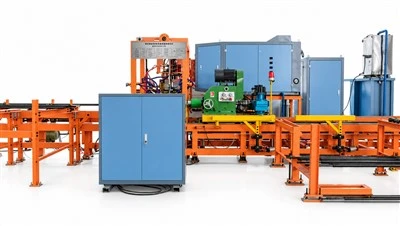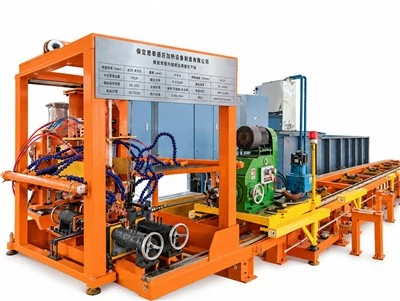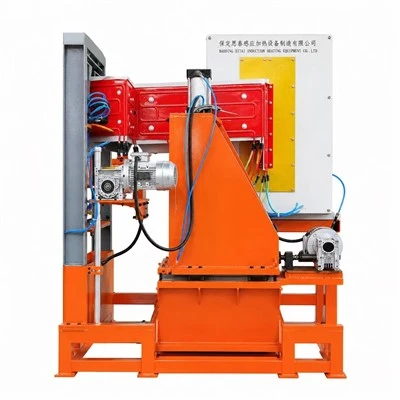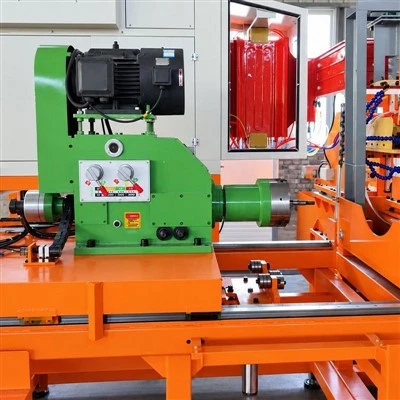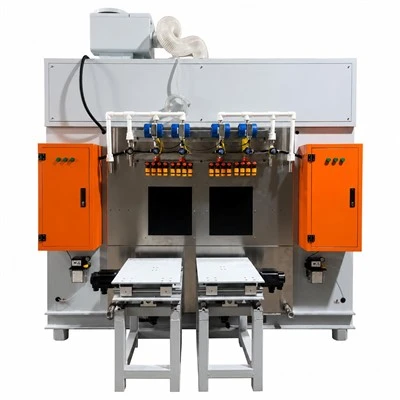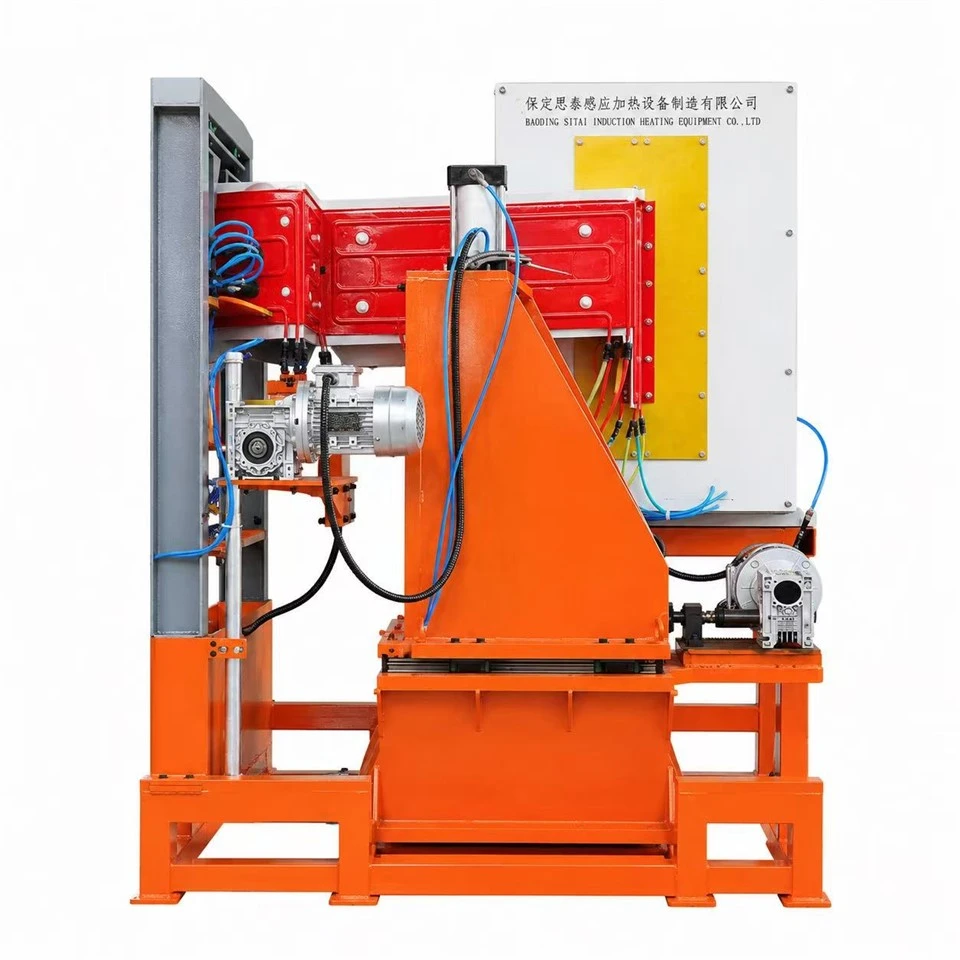


Baoding Sitai Induction Heating Equipment Manufacturing Co., Ltd. is one of the leading manufacturers and suppliers of high frequency fin tube welding machine in China. We are committed to providing high quality customized products with competitive price. Welcome to contact us for quotation.
High Frequency Fin Tube Welding Machine supplies and controls the welding energy at the fin-to-tube contact area while the mechanical winding system establishes the helical path.
With advanced high-frequency induction welding technology, the unit provides reliable bonding between the fin strip and tube surface, ensuring strong weld quality, consistent fin spacing, and smooth production operation.
High Frequency Fin Tube Welding Machine: it is widely used for manufacturing spiral fin tubes applied in heat exchangers, boilers, economizers, air coolers, and other industrial heat transfer equipment.
Main Components
High Frequency Welding System
The high-frequency welding system provides the required energy for continuous welding between the steel strip and the base tube.
It uses high-frequency induction heating technology to rapidly heat the welding area, allowing the fin strip to be firmly bonded to the tube surface without affecting the overall structure of the base tube.
Features:
- Stable high-frequency power output
- Fast heating response
- Efficient energy utilization
- Suitable for continuous production
- Reliable welding performance
Welding Head Assembly
The welding head assembly is the key mechanical unit that controls the contact and welding position between the fin strip and the tube.
Through precise adjustment of the welding rollers and guiding mechanism, it ensures stable pressure, accurate positioning, and uniform welding during the spiral fin forming process.
Features:
- Precise welding position control
- Stable strip guiding and pressing
- Adjustable welding parameters
- Improved welding consistency
- Suitable for different tube and fin strip specifications
Welding Control System
The welding control system coordinates the operation of the high-frequency power supply and mechanical production system.
It monitors and adjusts welding parameters to maintain stable production conditions and improve product quality.
Features:
- Intelligent operation control
- Real-time parameter adjustment
- Synchronized operation with production speed
- Easy operation and maintenance
- Improved production stability
Advantages
High Welding Strength
The high-frequency induction welding process creates a strong metallurgical bond between the fin strip and tube, improving heat transfer efficiency and product durability.
Stable Continuous Production
The integrated welding system allows continuous operation with consistent welding quality, reducing production interruptions.
Precise Welding Control
The coordinated control of welding power, production speed, and mechanical positioning ensures uniform fin tube quality.
Wide Application Range
The welding unit can be applied to various spiral fin tube production requirements, supporting different tube materials, fin materials, and production specifications.
Technical Features
|
Item |
Description |
|
Equipment Type |
High Frequency Welding Main Unit |
|
Application |
Spiral Fin Tube Manufacturing |
|
Welding Method |
High Frequency Induction Welding |
|
Welding Process |
Continuous Spiral Fin Welding |
|
Main Functions |
Heating, Welding, Control |
|
Operation Mode |
Continuous Production |
Application
The High Frequency Welding Main Unit for Spiral Fin Tube Production Line is applied where spiral fins are welded continuously to a rotating base tube. Typical finished products include:
- Spiral fin tubes
- Heat exchanger tubes
- Boiler tubes
- Economizer tubes
-
Air cooler tubes
-
Industrial heat transfer components
Why Choose Our Welding Main Unit
Professional design for spiral fin tube production
01
Stable high-frequency welding performance
02
Optimized welding structure for long-term operation
03
Easy integration with complete production lines
04
Suitable for industrial continuous manufacturing
05
High Frequency Welding Main Unit is the essential core section of the Spiral Fin Tube Production Line, providing stable welding performance and reliable production capability for high-quality spiral fin tube manufacturing.
Frequently Asked Questions
Q: How is high-frequency power matched to a spiral fin tube weld?
A: The required electrical condition depends on base-tube material and diameter, fin-strip material and thickness, fin geometry, production speed and the physical welding arrangement. The purpose is to heat the joining region rapidly enough for pressure welding without unnecessarily heating a large area of the tube. Power and frequency are therefore commissioned with the actual tube and strip, not selected from tube diameter alone.
Q: What is the role of the welding head compared with the HF generator?
A: The generator creates controlled high-frequency energy; the welding head determines how that energy and the mechanical contact condition are delivered to the fin-to-tube interface. Strip position, pressure, current path and the distance between the electrical coupling point and weld zone all influence the result. A stable generator cannot correct a fin that reaches the tube at the wrong angle or with inconsistent contact pressure.
Q: Why can weld quality change even when displayed power stays constant?
A: The same electrical output can produce a different local weld if tube surface condition, fin-strip edge condition, contact pressure, helix geometry or coupling position changes. Cooling temperature and component wear can also alter the electrical load. When a weld drifts, compare the power trend with tube rotation, strip position and the appearance of the joint instead of assuming the power cabinet is the only variable.
Q: What cooling circuits should be checked on an HF fin-tube welding unit?
A: Inspect the circuits serving power electronics, output components and the welding head or inductor as applicable. Confirm flow, pressure, temperature and cleanliness, and make sure hoses are not kinked after a setup change. A partial flow restriction may not stop the machine immediately but can change component temperature over a long run, so cooling alarms and routine checks are part of process stability.
Q: How should the welding system be interlocked with tube rotation and fin feeding?
A: High-frequency output should be enabled only when the mechanical section is in the qualified running condition. Run-permit, speed, stop and fault signals are coordinated so welding energy is removed during an abnormal loss of tube rotation or strip feed. The shutdown sequence is especially important because continued heating at a stationary point can damage the tube, fin or welding components.
Q: Can the same HF main unit weld both solid and serrated helical fins?
A: It may support both when the electrical capacity and output arrangement cover the required process window, but the mechanical strip preparation and contact conditions differ. Serration changes fin flexibility and the way the strip approaches the tube. Each fin type should therefore have its own qualified welding recipe and mechanical setup rather than sharing one power setting by default.
Q: What information is needed for a replacement HF welding main unit?
A: Provide existing generator data, plant power supply, tube and fin ranges, normal production speed, current output connection, welding-head photographs or drawings, cooling-water conditions and the line-control interface. If the purpose is to solve a quality problem, include representative defective and acceptable weld samples so the replacement project addresses the real process rather than only matching the old nameplate.
Q: What should be recorded during fin-tube welding commissioning?
A: For each qualified product, record tube material and size, fin strip specification, fin pitch, production speed, mechanical pressure setting, welding power parameters, coupling position and cooling conditions. Keep a sample showing the accepted bond. This creates a process reference that can later distinguish normal product-to-product adjustment from an equipment fault.
Q: What can cause repeated resonant-capacitor overheating in a fin-tube HF welding system?
A: Capacitor temperature can be affected by electrical loading, cooling, connection resistance and operation outside the intended resonant condition. Loose bus joints or reduced water flow can create localized heating even when the average power appears normal. A failed capacitor should therefore trigger inspection of the surrounding circuit and operating record; replacing the component without finding an abnormal load or cooling condition can lead to another failure.
Q: Why should high-frequency output conductors be kept compact and mechanically secure?
A: The output path carries high-frequency current, so conductor spacing, loop area and connection quality influence inductance and loss. Movement or loose joints can also change the load presented to the inverter. The physical output layout is therefore part of the welding circuit, not ordinary low-frequency cabling. Changes made during maintenance should preserve the engineered geometry and cooling clearances.
Q: How can the welding unit be checked after a major electrical maintenance intervention?
A: Before returning to production, verify connections, insulation, cooling flow, protective interlocks and the no-load or low-load checks specified for the equipment. Then run a qualified tube-and-fin recipe at conservative conditions and compare current, power and weld appearance with the previous reference. A controlled verification is safer and more informative than immediately returning to maximum production speed.
Q: How does fin-strip surface contamination affect the electrical welding load?
A: Oil, heavy oxide or inconsistent scale can change contact conditions at the weld interface and make the effective load less repeatable. The generator may respond normally while the local bond quality changes. Surface preparation requirements should therefore be defined for the tube and strip, and a sudden change in electrical behavior should be compared with material condition as well as with the power cabinet.
Q: Why should the inductor or contact assembly position be documented for each fin-tube recipe?
A: Small changes in coupling distance and orientation can alter current concentration at the weld. Marking or recording the qualified mechanical position makes setup repeatable after maintenance and prevents operators from compensating for a shifted welding head only by increasing power. Mechanical reference dimensions are especially useful when the same machine changes between tube diameters.
Q: Which electrical protection events should be reviewed after an unexpected HF welding trip?
A: Record the exact alarm, line speed and operating condition before resetting the system. Overcurrent, cooling, DC-link, inverter or load-related trips point to different diagnostic paths. Inspect the weld station for a simultaneous mechanical event such as loss of strip contact or a tube stop. Preserving the alarm history helps separate a real power-stage fault from a protection response triggered by a sudden change in the welding load.
Q: Why is grounding and shielding important around an HF fin-tube welding system?
A: High-frequency equipment can create electromagnetic noise that affects nearby sensors and control wiring if installation practices are poor. Cabinet grounding, cable routing, shielding and separation of power and signal circuits should follow the engineered layout. A control fault that appears only while welding power is enabled may therefore require an installation review as well as a software check.
Hot Tags: high frequency fin tube welding machine, China high frequency fin tube welding machine manufacturers, suppliers, factory