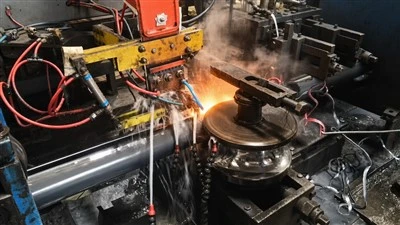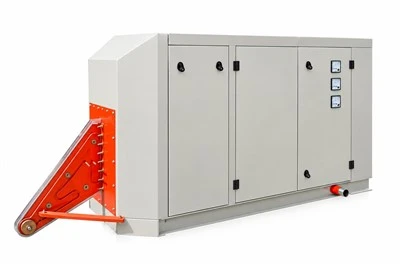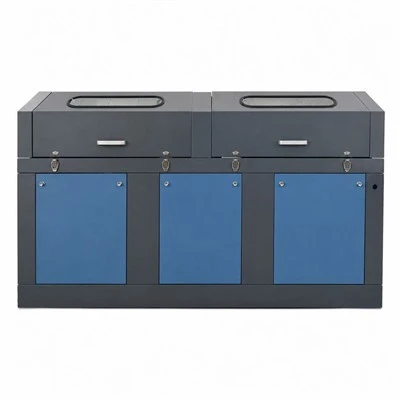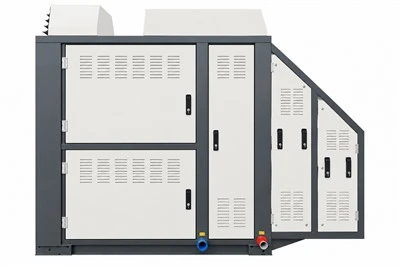
Baoding Sitai Induction Heating Equipment Manufacturing Co., Ltd. is one of the leading manufacturers and suppliers of wire annealing machine in China. We are committed to providing high quality customized products with competitive price. Welcome to contact us for quotation.
Continuous Heat Treatment Solution for Improved Wire Performance and Production Stability
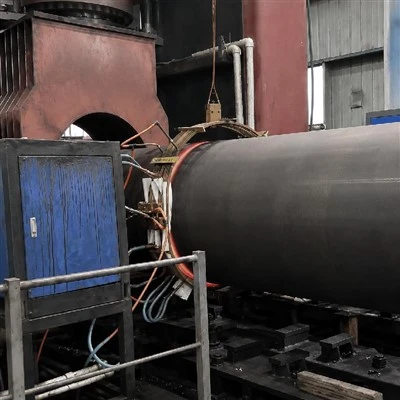
Online Wire Annealing System for Cored Wire Production Line provides an in-line heating stage where the wire process requires controlled softening or stress reduction before downstream handling.
By integrating the annealing process directly into the production line, the system enables continuous wire treatment without interrupting production, improving overall efficiency and consistency of finished wire products.
Main Features
Continuous Online Annealing Process
The system performs heat treatment during continuous wire movement, allowing seamless integration with automatic production lines and reducing additional handling operations.
01
Improved Wire Formability
The annealing process helps reduce internal stress and improve wire flexibility, supporting smoother forming, feeding, and subsequent processing.
02
Precise Heating Control
The system adopts controlled heating technology to maintain stable annealing conditions, ensuring consistent treatment quality throughout continuous production.
03
Stable Industrial Operation
Designed for long-term production environments, the equipment features a reliable structure and efficient cooling system to support continuous operation.
04
Easy Integration with Production Lines
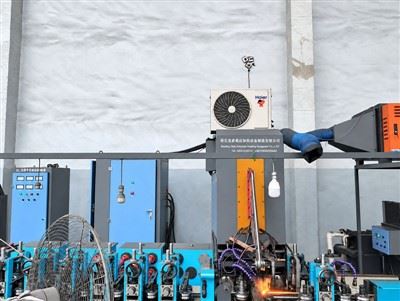
When the production route requires it, the Online Wire Annealing System for Cored Wire Production Line can be integrated with feeding, forming, welding, sizing and take-up equipment. The actual heating target must be qualified for the wire material and product structure.
05
Applications
The Online Wire Annealing System is mainly used for:
- Cored wire production lines
- Calcium wire manufacturing systems
- Metal wire processing lines
- Continuous wire forming and treatment equipment
Technical Advantages
- Continuous online wire annealing
- Improves wire flexibility and processing performance
- Reduces residual stress in wire materials
- Stable temperature control for consistent quality
- Suitable for automatic continuous production
Customized Wire Processing Solutions
SITAI provides complete solutions for cored wire and metal wire production systems, including strip pay-off units, wire feeding equipment, powder filling systems, welding equipment, sizing machines, annealing systems, and finished wire collection equipment.
According to different wire materials, diameters, production speeds, and process requirements, SITAI can provide customized annealing solutions to achieve stable and efficient wire manufacturing.
Frequently Asked Questions
Q: Why place annealing inside a cored wire production line instead of treating the wire later?
A: An online annealing stage can condition the wire continuously at the point required by the production route, avoiding an additional batch-handling step. In a cored wire line, the objective may be to reduce residual stress or improve flexibility before downstream straightening and coiling. The heat-treatment window must be coordinated with line speed and with the actual sheath and core materials; it is not a universal temperature recipe.
Q: How should annealing power react when the cored wire line accelerates?
A: The residence time in the heating zone becomes shorter as line speed increases, so the power command should follow a qualified speed-to-energy relationship. A practical control strategy uses the line-speed signal as a feed-forward reference, with temperature or product checks used to confirm the result. The transition should be tuned so the wire is not overheated at low speed or under-treated during acceleration.
Q: Can online annealing damage the material inside a cored wire?
A: It can if the selected temperature, exposure time or atmosphere is incompatible with the core material. Reactive or temperature-sensitive cores require special review, and the process may be intended primarily for the steel sheath rather than the filling material. Before production, the wire construction and metallurgical objective should be defined so the annealing recipe does not create an unwanted reaction inside the sealed product.
Q: Where should the induction coil be positioned relative to welding and sizing?
A: The position depends on why the heat treatment is needed and on the mechanical condition of the wire at each stage. The project should consider weld completion, residual deformation, available straight length, cooling distance and the requirements of the next machine. The best location is therefore determined from the entire line layout rather than placing the annealer at a fixed distance used on another installation.
Q: What should be monitored to confirm stable online annealing?
A: Record line speed, power, the selected recipe and a reliable indication of product temperature or downstream material response. Also watch wire position through the induction zone because an off-center wire can change coupling. Periodic mechanical tests or bend comparisons can be used to confirm that the thermal process continues to deliver the intended property, especially after a coil or material batch change.
Q: How is an online annealer integrated with the main line safety system?
A: The annealing unit should exchange run-permit, line-speed, stop and fault signals with the line controller. Loss of cooling, an abnormal power condition or a stopped wire should trigger the defined protective response. The exact interlock sequence is agreed during engineering so the heating source cannot continue operating when the product is stationary in the coil unless a specifically qualified mode requires it.
Q: What information is required to size an annealing section for cored wire?
A: Send the wire outside diameter, sheath material, core material, incoming mechanical condition, desired treatment result, normal and maximum line speed, available installation length and plant electrical/cooling conditions. A sample or current production data can be valuable when the target is defined by bendability or downstream behavior rather than by a single temperature value.
Q: How does this cored-wire annealer differ from a general metal-wire annealing machine?
A: The online cored-wire version is engineered around a composite product and its position inside a production line. Heating must consider the closed sheath, internal core and the process stages before and after the annealer. A general wire annealer may serve solid steel, copper or aluminum wire with different metallurgical objectives. The control logic, coil design and acceptable temperature window therefore need separate engineering even when both systems use induction heating.
Q: How should an annealing section be handled when the cored wire contains a heat-sensitive core material?
A: The thermal review must consider what is inside the sheath as well as the steel shell. A core that reacts, softens or changes behavior at elevated temperature may limit the permissible wire temperature or require the annealing objective to be achieved with a shorter, more localized cycle. Product samples should be evaluated after treatment so improved sheath flexibility is not obtained at the expense of the intended core condition.
Q: Can online annealing be used specifically to improve downstream coiling behavior?
A: It can be designed with that objective when excessive residual stress in the sheath is contributing to springback or difficult package formation. The result should be judged at the coiler using the same finished-wire geometry and coil diameter planned for production. If poor coiling is caused by sizing misalignment or excessive take-up tension, annealing alone will not remove the mechanical source of the problem.
Q: What happens if cooling after the cored-wire annealer is too short?
A: The wire may enter guides, straighteners or the coiler at a temperature that changes friction, handling stiffness or operator safety conditions. The layout therefore needs enough controlled cooling distance for the selected line speed. Cooling must also avoid sudden thermal treatment that conflicts with the intended metallurgy. The downstream entry temperature should be part of the commissioning check, not an assumption based only on coil exit temperature.
Q: Should online annealing be placed before or after final sizing on a seamless cored wire line?
A: That choice depends on which residual stresses the process is intended to relieve and how much dimensional correction remains after heating. Annealing before final sizing can leave a later calibration step to restore geometry; annealing after sizing avoids another major deformation step but requires the hot wire to enter cooling and take-up without losing shape. For welded seamless cored wire, the location must also respect weld completion and the stability of the closed sheath.
Q: How is off-spec wire handled during annealer startup and shutdown?
A: A defined transition length should be identified while power, speed and temperature are moving between zero and the qualified steady condition. That section can be marked or separated according to the customer's quality procedure. Coordinating the annealer with take-up and length tracking helps prevent transition material from being mixed into an accepted finished coil, which is particularly important when the line runs long continuous batches.
Q: What should be reviewed when annealing a welded sheath around a solid calcium core?
A: The process must protect both the welded steel enclosure and the reactive calcium core. Heat input, residence time and cooling are selected so the sheath receives the intended conditioning without creating an undesirable core response. The trial should inspect seam condition, finished diameter, bend behavior and the state of the enclosed core. A recipe developed for ordinary solid steel wire should not be transferred directly to this composite product.
Q: Can annealing correct a seam that was poorly welded upstream?
A: No. Heat treatment may change residual stress or ductility, but it cannot restore a longitudinal joint that was incompletely fused, misaligned or mechanically open. If cracks or seam opening are found after annealing, inspect pre-anneal samples and welding records first. The annealer should receive wire that already meets the required seam condition; otherwise thermal processing can make the defect easier to see without removing its cause.
Hot Tags: wire annealing machine, China wire annealing machine manufacturers, suppliers, factory