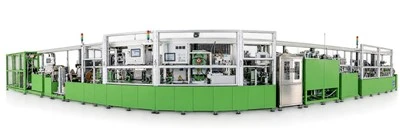
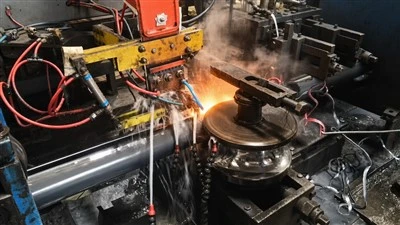
Pre-welding Treatment Unit
Designed to thoroughly remove high-melting-point oxide films from copper and aluminum surfaces, ensuring effective wetting by the brazing filler metal:
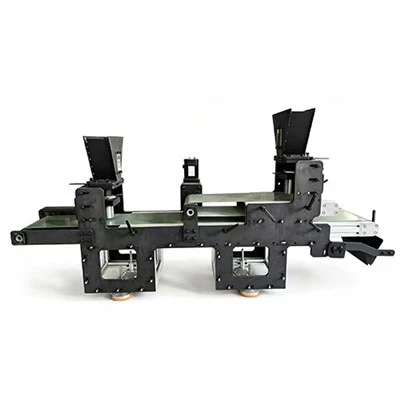
Fixed-length tube cutting machine: Servo-driven with a cutting precision of ±0.1mm; compatible with Φ6–30mm copper-aluminum tubes; produces burr-free, deformation-free cuts to provide qualified base material for subsequent joining processes.
Specialized joint pre-forming machine: Machines the copper tube end into a socket structure; ensures the radial gap after aluminum tube insertion is strictly controlled between 0.05mm and 0.2mm, guaranteeing consistent weld seam formation.
Chemical activation tank assembly: Includes a sulfuric acid activation tank (for copper), an alkaline degreasing tank (for aluminum), and a mixed-acid pickling/passivation tank; equipped with a constant-temperature control system to precisely manage immersion times and solution temperatures for each process.
Automatic drying line: Hot-air circulation type (60–80°C); thoroughly dries residual moisture from the tube surfaces after pre-treatment to prevent porosity defects during welding.
Core Welding Unit
The heart of the production line, determining the mechanical strength and sealing integrity of the joint:
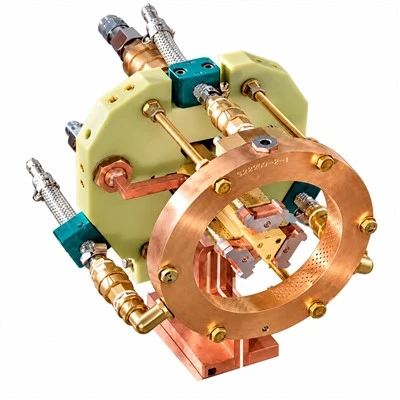
High-frequency induction brazing main unit: Standard power range of 5–15kW and frequency of 200–400kHz; achieves heating rates of up to 100°C/second; features an asymmetric power output module (40% power to copper, 60% to aluminum) to keep the temperature difference between the two sides within ±20°C.
Customized induction tooling system: Uses C-shaped open induction coils (inner diameter 2–5mm larger than the tube) paired with magnetic flux concentrators; heating zone deviation ≤±0.1mm; dual-station servo-driven rotary table with ±0.05mm positioning accuracy and a cycle time of ≤15 seconds per station.
Intelligent temperature control system: Infrared pyrometers (±1°C accuracy) monitor weld point temperatures in real-time; PLC dynamically adjusts output power to keep temperature fluctuations within ±3°C, preventing overheating and the formation of thick, brittle intermetallic layers.