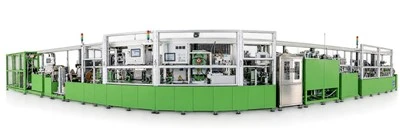
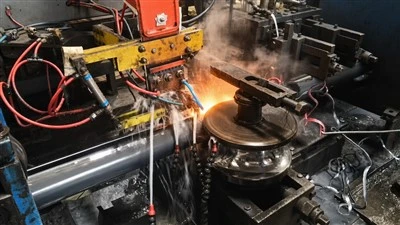
Core Working Principle
The production line leverages the differences in thermal conductivity and melting points between copper and aluminum materials to specifically address three key challenges: thermal field imbalance, the formation of brittle phases, and the difficulty of breaking down the oxide film.
Thermal Field Compensation Control: A PLC is used to set an asymmetric power output-allocating 40% of the power to the copper side and 60% to the aluminum side-to maintain the temperature difference between the two sides within ±20°C. This compensates for the disparity in thermal diffusion caused by copper's thermal conductivity (401 W/mK) being significantly higher than that of aluminum (237 W/mK).
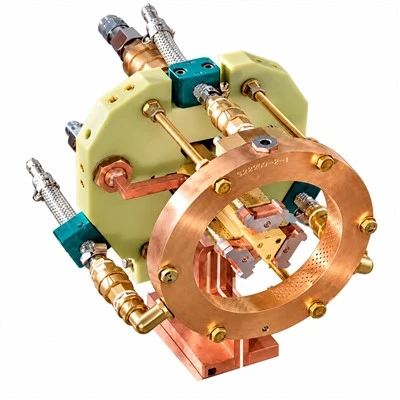
Metallurgical Bonding Mechanism: An Al-Si-Cu-Ni composite filler metal (melting point: 560–580°C) is employed. Electromagnetic induction or resistance heating melts the filler within 5–7 seconds; capillary action then draws the molten filler into the molecular gaps of the tube materials, while the process inhibits the formation of brittle intermetallic compounds such as CuAl₂.
Oxide Film Pre-treatment: A dual-stage process involving mechanical grinding and chemical activation completely removes the Al₂O₃ oxide layer (which has a melting point of 2054°C) from the aluminum surface, ensuring the filler metal achieves optimal wetting at the weld interface.